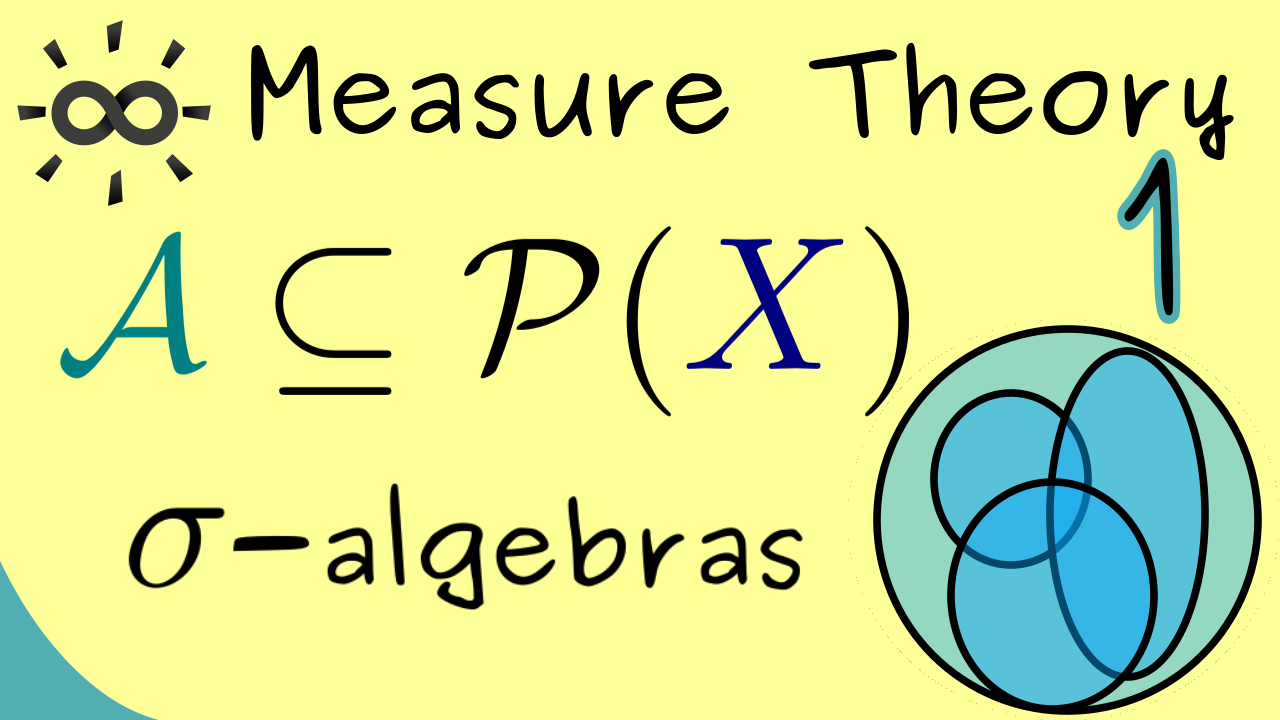
1 \(\sigma\)-Algebra
A sigma algebra \(\mathcal{A}\) on a set \(X\) is a nonempty set of subsets of \(X\) that is closed under complement, countable union, and countable intersection. In other words:
$$\begin{aligned} &\mathcal{A} \subseteq \mathcal{P}(X) \text{ is a } \sigma\text{-algebra on }X\text{ if:} \\ (a) \text{ } &\phi, X \in \mathcal{A}& \\ (b) \text{ } & A \in \mathcal{A} \implies A^c \coloneqq X \setminus A \in \mathcal{A} \\ (c) \text{ } & A_i \in \mathcal{A}, i \in \mathbb{N} \implies \bigcup^\infty_{i=1} A_i \in \mathcal{A}\end{aligned}$$\(A \in \mathcal{A}\) is also called a \(\mathcal{A}\)-measurable set. In other words, a measure (which is a kind of generalised notion of volume) can be assigned to a \(\sigma\)-algebra. This notion is formally established later in Measure
1.0.1 Borel \(\sigma\)-Algebra
For every \(\mathcal{M} \subseteq \mathcal{P}(X)\), there is a smallest \(\sigma\)-algebra that contains \(\mathcal{M}\):
\[\sigma(\mathcal{M})\coloneqq \bigcap_{\begin{aligned} &\mathcal{A}\supseteq \mathcal{M} \\ &\mathcal{A} \text{ } \sigma \text{-algebras} \end{aligned}} \mathcal{A} \space \space \leftarrow \sigma\text{-algebra generated by }\mathcal{M}\]
Note that uncountable unions of \(\sigma\)-algebras (\(\mathcal{A}_i \subseteq \mathcal{P}(X), i \in \text{index set (uncountable)}\)) are again valid \(\sigma\)-algebras. Easily provable using the original \(\sigma\)-algebra definition.
A Borel \(\sigma\)-algebra on a topological space \((X, \tau)\) (noted as \(\mathcal{B}(X)\)) is the \(\sigma\)-algebra generated by the open sets \(\tau\). In other words:
\[\mathcal{B}(X)\coloneqq \sigma(\tau)\]
These Borel \(\sigma\)-algebras have some interesting properties that allow us to define a measure, or a generalised notion of volume, upon them, which we will later find is impossible to do on the entire powerset \(\mathcal{P}(X)\)
1.0.2 Measure
Let us say that \((X, \mathcal{A})\) is a measurable space.
$$\begin{aligned} &\text{A map } \mu \colon \mathcal{A} \rightarrow [0, \infty) \cup\{\infty\} \text{ is called a measure if:} \\ (a) \space & \mu(\phi) = 0\\ (b) \space & \mu\biggl(\bigcup_{i=1}^n A_i \biggr) = \sum_{i=1}^{n}\sigma(A_i), \space\space\space\space\space\space\space\space \text{with }A_i \cap A_j = \phi, i \neq j \text{ }\forall \text{ countable sequences } A_i \in \mathcal{A}\end{aligned}$$Collectively, \((X, \mathcal{A}, \mu)\) are referred to as a measure space.